

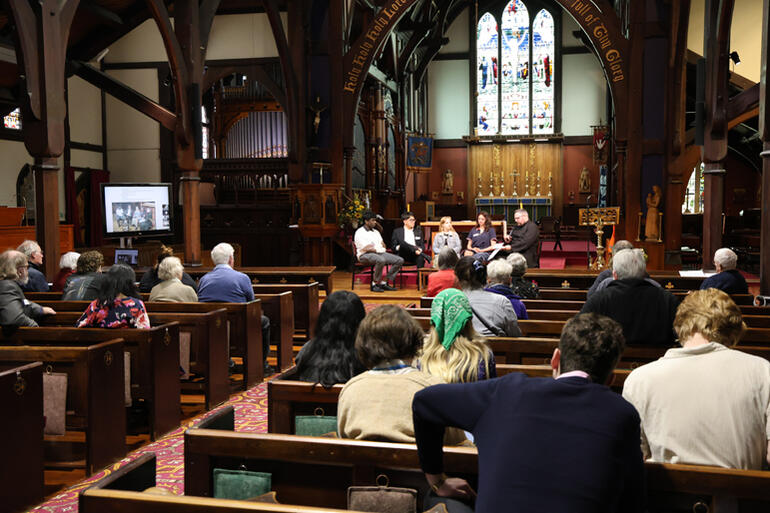
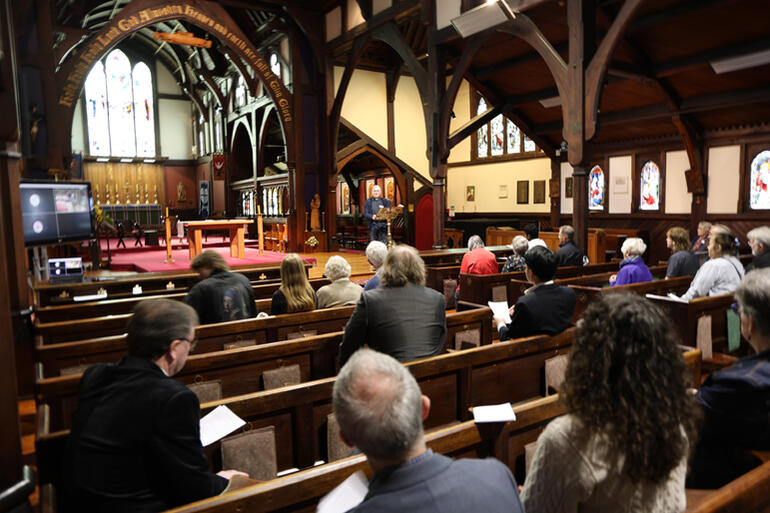
Young voices formed the heart of this year's Anglo-Catholic Hui meeting at St Michael and All Angels' Anglican Church in Otautahi Christchurch on 13 November, as 50+ Anglicans met in person, while more from Wellington and Australia and joined online for the one-day hui.
Former Dean of Christchurch Rev Peter Beck was delighted to hear from young people involved in Anglican-Catholic churches.
"I very encouraged by what I've heard here today, it gives me hope for the future of our church." he said.
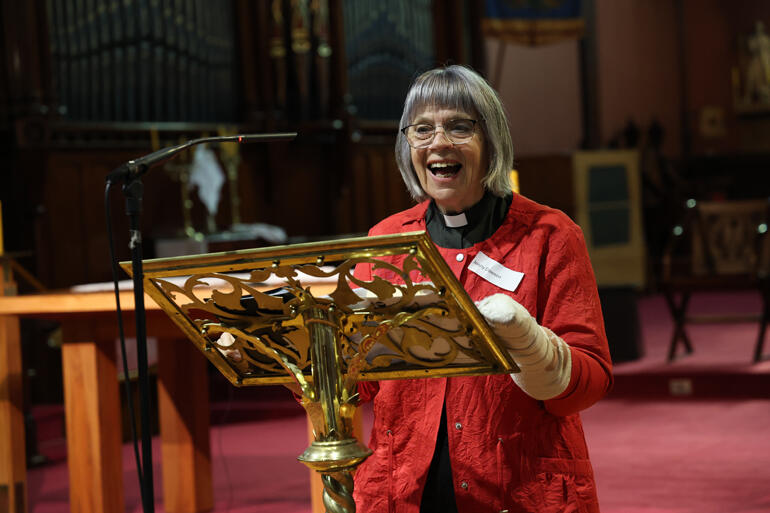
Opening the day, the Rev Dr Jenny Dawson set the scene in the Hui's first session with her Bible study on Luke 2:41-52, the story of Jesus being drawn to the temple in Jerusalem. She wove together poetry by Anglo-Catholic Christchurch poet Ursula Bethel and Alan Curnow who grew up in vicarages throughout Canterbury.
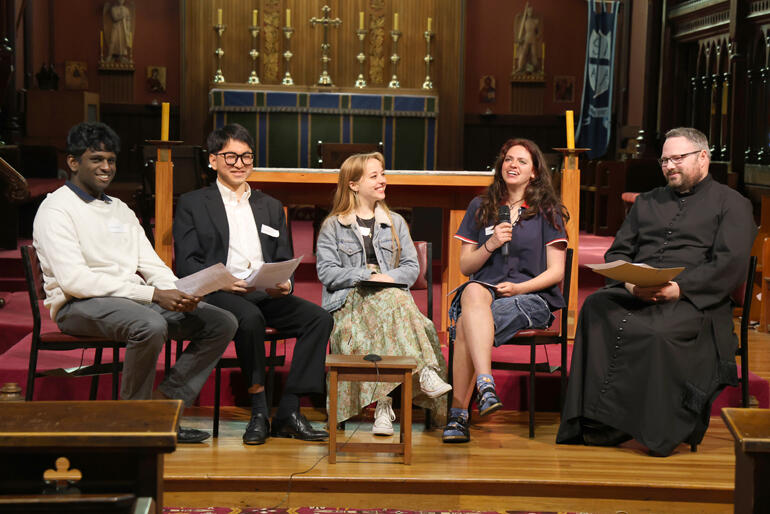
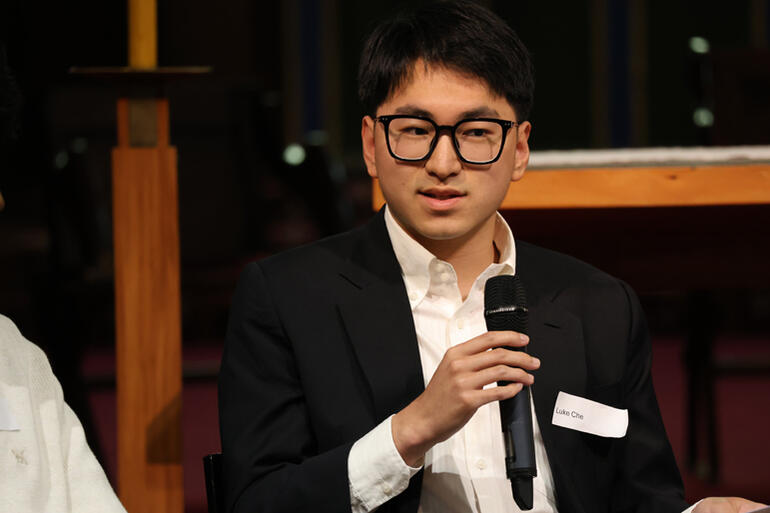
Four South Island Anglicans formed the hui's youth panel moderated by Dunedin's Vicar of Caversham the Rev John Graveston, who till recently was the Child, Youth and Family Educator for the Diocese of Dunedin.
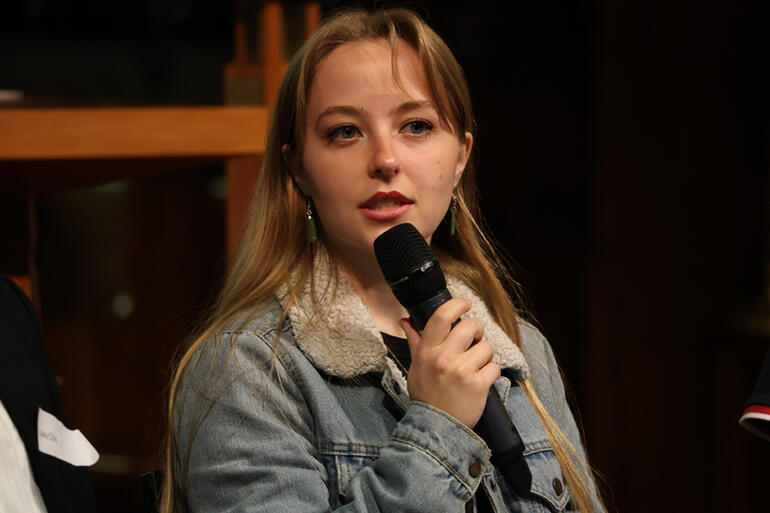
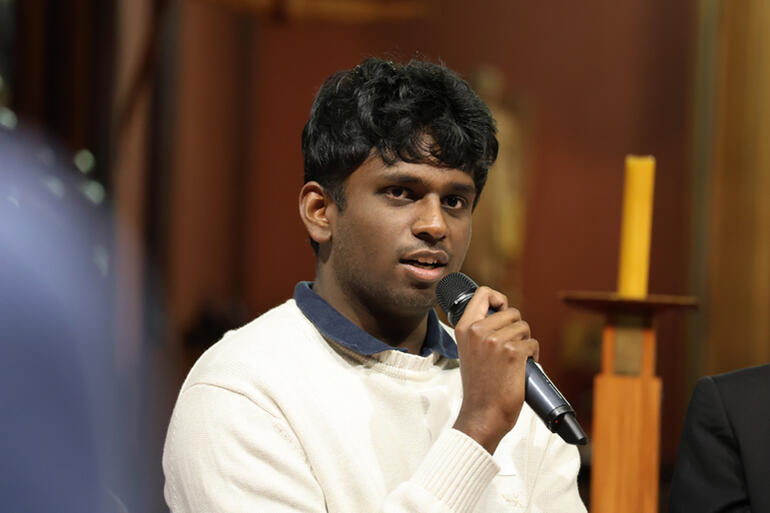
The youth panel included: Luke Che (19) (Riccarton – Spreydon, St Martin – St James, Christchurch), Ava Gleason (23)( All Saints' and St Paul's Cathedral Dunedin), Thomas Visakan (17)( St Michael and All Angels, Christchurch) and Theodora Clarke-Wallace(17)(All Saints' Dunedin), who each spoke on what attracted them to Anglo-Catholic worship and community.
Together they raised challenges for church leaders on welcome and belonging, encouragement to lead, worship with gravitas, comfort with questioning and church communities that are more loving than judging.
Cradle Anglo-Catholics Thomas and Theodora talked about the importance of being part of a loving and supportive church community.
"After my family moved to New Zealand from Malaysia, St Michael's was the first place we found that just welcomed us..." Thomas said.
Thomas says that's a quality that churches can offer to anyone if they are building a community on shared values and spiritual growth.
"That's something that I value and I think a lot more people could do with." he said.
While both Luke and Ava grew up in liturgically low and theologically conservative churches, in Asia and in Texas, both have come to appreciate the beauty of more diverse church traditions, including 'high church'.
For Luke it's the fascination of diverse worship styles and theologies that keep him coming back, and for Ava it's looking deeply at faith and grappling with how the Bible applies to life.
"My community at home was mostly culturally Christian, and as a young person I took church very seriously and took reading scripture and studying it very seriously." she said.
"Then when I moved to New Zealand on exchange, I found a community of young people who were challenging the scriptures and the church in the way that I wanted to see my own community back home do, and that's inspired me to move into this more liturgically high tradition that I think honours the long and deep history of the church."
For the panellists the style of worship with candles, hymns, brocade, chant, processions, bells and smells helped lead them into prayer. For Theodora the look and feel of a church crafted in wood and glass that holds the symbols and stories of the faith helps her contemplation.
"Obviously you can pray anywhere, but instead of praying in a school gym full of year sevens, you can be in a beautiful space where you get lost in the stories and the art and the music and your mind and your prayers go from there."
For Ava, the big difference between her nondenominational Christian worship experiences and her worship through Anglican liturgy in Aotearoa, is the respect and reverence for the Eucharist she has found here.
"In the church that I grew up in, (Holy Communion) is much more symbolic and not so honoured, and there's not this gravity to it."
"When I experienced that gravity in high liturgy, to me it's this understanding and honour for not only the tradition of the faith, but for Christ Himself."
For Thomas the beauty of the liturgy and the church buildings reflects not only the history and stories of the faith, but the beauty of its community.
"The thing about all this, is it requires a lot of different people to put in their time, effort, and work, and I think that draws the community together. "
"You know, you feel like a part of something if you contribute something to it, and that draws everyone closer, and gives us a sense of belonging, which I think is really important."
Jessica Hughes (who is youth worker at St John the Baptist Northcote and Administrator at Albany Greenhithe in Auckland) agreed that making a real and valued contribution is critical to feeling engaged in church as a young person.
"I'm a cradle Anglican and I've been involved in the church a long time, but really what drew me in was being encouraged to serve, so I originated as a reader, then a liturgist, then on Cathedral council and it goes on."
Turning to the value of liturgy, Theodora pointed out that in the digitally-driven world young people live in, churches can offer an alternative.
"Everything we're supplied with on social media is so quick – it's here's the next thing, here's the next thing. You get a new dopamine hit from everything, and I think young people are sometimes looking for an escape, to just sit in a quieter more traditional service and to think, to be with themselves and be with God."
Luke and Ava agreed there's great attraction in tradition, as Fr John recounted recent US and UK statistics that show an increase in young men joining the Catholic church. But she cautioned it's important to keep a critical eye on reviving things of the past.
"I have seen firsthand, and in my experience, that sometimes a return to a Catholic tradition is a symptom of a return to what they see as 'traditional values' or 'traditional family values', (in the United States, at least).
"And we all know that Christianity and religion has been used in America historically to justify things that cannot and should not be justified."
Luke joined Ava to question what is really drawing young men to Catholic churches.
"Are they there to trace the roots of the early church through that Catholic liturgical expression, and are they also turning to the early church's embrace of Jesus's teaching to really love your neighbour, to seek justice, to include?" he asked.
Rev John Graveston jumped off script to ask the panel what they thought of young Christian influencers, the social media personalities who promote their views and perspectives on religious doctrine, life and practice through soundbite-length videos.
Ava raised the point that much of online Christian social media is produced by conservative US megachurches, but she has also found gentler content that she values for its effect of humanising Christians: nuns playing basketball, a Catholic priest making ASMR soundscapes, or an Orthodox Christian artist's woodblock printed icons. "It shows we're not just people who pray all the time, but normal people who live every aspect of life."
Luke Che said that because algorithms favour strong and controversial statements, many influencers choose the hardest edges of doctrine to score more reactions and followers. But he also believes that's no excuse for churches to step away from social media.
"We (the church) are not having a great time with presenting our loving and inclusive Christian faith in the online space. So that's a concern to me."
"But I do see a future where the Christian church presents a Christ-centered message of how we see the world, and how we want to approach the world, and how we want to be the light in the world."
Theodora agreed that one of the biggest problems with inviting her peers to church is that often it's only extreme views from Christianity that reach their feeds.
"The media definitely presents a negative view of the church, and some people are kind of stuck in that...and the ways that some people in the world have abused the church and chosen parts of the Bible to follow which do not actually represent the values."
"I think something the Anglican Church does very well is preach "love everybody", – you don't have to have all these ideas you don't want, just "Love God, love everybody".
Thomas said coming to church might help his peers get a better idea of what Christianity is, but he's not about to invite them for the liturgy or the theology.
"If I want to invite my friend to church, I have an easier time saying, "Hey, do you want to come sing in the choir? or "Do you want to come to our church and meet this person I know?"
"The liturgy and the theology is a very complex thing, and a lot of us are still figuring that out ourselves. So putting that on the forefront could serve as a barrier of entry."
Thomas thinks for Anglo-Catholics as for any church there needs to be an understanding that "belief" is something that comes later.
"What people are looking for is the sense of community that we have and belonging, and that is what we should be putting forward, and maybe a shift of focus on that because obviously the liturgy aspect and faith is at the heart of what we're doing, but to bring people in, I feel like community is the most effective way."
Further sessions at the Anglo-Catholic Hui looked at prophetic imagination, Education for Ministry, Music the Handmaid of the Liturgy, and the Renewal of Catholic Anglicanism.
For more info on the Hui watch this space and go to: anglocatholichui.nz











Comments
Log in or create a user account to comment.