

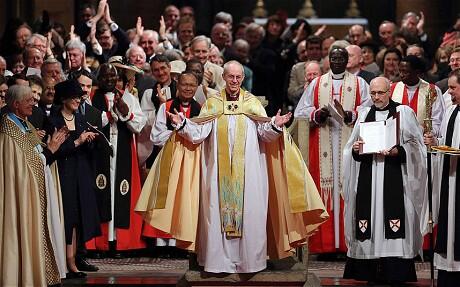
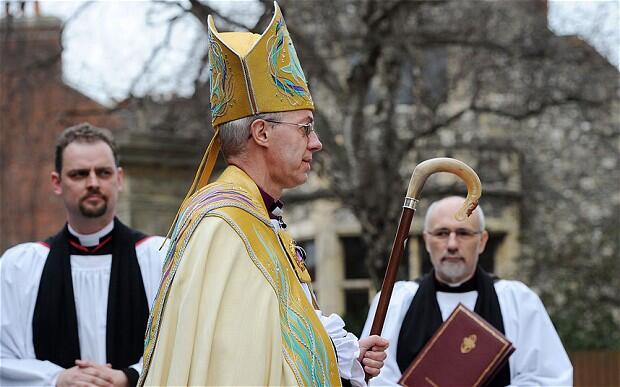
The Archbishop of Canterbury, the Most Rev Justin Welby, was enthroned on Thursday in Canterbury Cathedral, at a service that combined tradition with modern reminders of his international position in the Anglican Communion.
Great emphasis was placed during the service on the relationship between the Anglican church and its ecumenical partners. Although the African element only constituted one element of the service its colourful impact made it one of the most memorable.
Among the congregation, which had sung nine hymns by the end of the service, were the Prince of Wales, representing the Queen, accompanied by the Duchess of Cornwall, and Prime Minister David Cameron, as well as other members of the Government, including the Home Secretary, Theresa May, and the Lord Chancellor, Chris Grayling.
The Leader of the Opposition, Ed Miliband, also attended. Local civic dignitaries from the city and county were also out in force, led the Lord Lieutenant, Lord De L'Isle.
Ecumenical representatives included Archbishop Gregorios of Thyatiera and Great Britain; the Moderator of the Free Churches Group, the Revd Michael Heaney; and Metropolitan Hilarion, Hierarch of the Russian Orthodox Church Outside Russia. Cardinal Kurt Koch, President of the Pontifical Council for Promoting Christian Unity, came from the Vatican.
There were also a number of Roman Catholic Benedictine religious, including Dom Richard Yeo, the Abbot-President of English Benedictine Congregation. A former Archbishop of Canterbury, Lord Carey of Clifton, was present as a guest of the Dean and Chapter.
Three knocks on the West Door
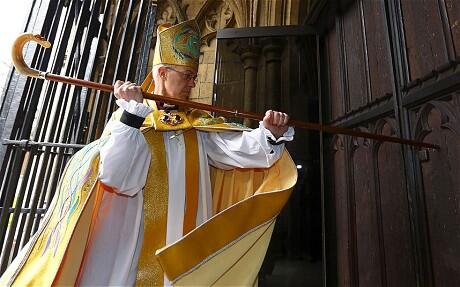
During the processions before the service, the congregation had already sung three hymns (including "Great is Thy faithfulness" and "Come down, O love divine"), by the time the Archbishop knocked on the West Door three times with his pastoral staff.
The doors were opened, to a fanfare, and he was welcomed with formalised questions about his ministry, composed by him and put to him by a 17-year-old representative of the Anglican Communion, Evangeline Kanagasooriam, a pupil at the King's School, Canterbury. The Archbishop answered that he came "in weakness and fear and in much trembling".
In keeping with the season, Archbishop Welby proceeded to the nave altar during the singing of "When I survey the wondrous cross". There he knelt in silence, before another hymn, the ancient "Veni Creator".
Having made necessary legal declarations and kissed the Canterbury Gospels (brought to England in 597 by his predecessor St Augustine), the Archbishop added his signature to those of the other Co-Presidents of Churches Together in England on an ecumenical covenant.
Readings followed from Ruth and 2 Corinthians, the latter read by the Archbishop of Westminster, the Most Revd Vincent Nichols. The hymn "The Church's one foundation" preceded the enthronement in the diocesan throne, after which the hymn "Saranam", to a Punjabi melody, was sung.
Then the Dean of Canterbury, the Very Rev Robert Willis, placed the Archbishop in the Chair of St Augustine as Primate of All England and Metropolitan. The Archbishop of Burundi, the Most Revd Bernard Ntahoturi, blessed him in French.
Sustained applause greeted the Archbishop as he was presented to the congregation by the Dean, and was repeated at the end of the service as the archbishop processed out. Archbishop Welby then introduced the peace, which the congregation then shared, during which the hymn "In Christ alone" was sung, a favourite among conservative Evangelicals.
This was followed by a song and dance, "Gbeh kpa kpa ba", performed by a London-based group, Frititi, using elements of melodies from Ghana. The dancers led the Archbishop to the pulpitum screen, where he proclaimed the Gospel. The passage was from Matthew 14, the account of Jesus' walking on water.
The dance continued after the reading, as the Archbishop returned to the Chair of St Augustine, and preached the sermon.
An organ improvisation followed the sermon, during which symbols representing regions of the Anglican Communion were placed on the high altar.
The Nicene Creed that followed omitted the filioque, after which the choir sang Benjamin Britten's Te Deum in C.
Intercessions were then led by representatives from the diocese of Canterbury, ending with the General Thanksgiving from the Book of Common Prayer.
A new anthem by Michael Berkeley set words from the Rule of St Benedict, "Listen, listen, O my child". It had been specially commissioned for the service by Archbishop Welby's mother and step-father, Lord and Lady Williams of Elvel.
The Archbishop then blessed the congregation in the quire, and processed to the nave altar during the singing of Charles Wesley's "And can it be . . .?" There he blessed the congregation in the nave, after which the processions left the cathedral.
The Archbishop was escorted to the Chapter House, and placed in his seat by the Dean, where he received the oaths of obedience from the Chapter and members of the foundation, including all the choristers, lay clerks, and Scholars of the King's School, Canterbury.
After this, the Dean closed proceedings with the traditional prayers in Latin, asking God's blessing on the cathedral community.
The Archbishop then retired to the Deanery.
Same-sex marriage
On Thursday Archbishop Welby addressed the question of same-sex marriage, saying that some gay couples had loving and monogamous relationships of "stunning quality".
He said he backed the church's traditional view of marriage as the union of one man and one woman, but he had witnessed the strength and profundity of same-sex love in the relationships of some of his friends.
"You see gay relationships that are just stunning in the quality of the relationship," he told the BBC, adding that he had "particular friends where I recognise that and am deeply challenged by it".
It emerged that Welby sent a letter on Wednesday night to the human rights campaigner Peter Tatchell, offering to meet him face to face.
The invitation was in response to an open letter in which Tatchell accused Welby of being homophobic by opposing gay marriage and said some local Anglicans had colluded in persecution of gay people in Africa.
In his response, the Times reported, Archbishop Welby thanked Tatchell for his "very thoughtful" letter and said the points he had made were "powerful"










Comments
Log in or create a user account to comment.