

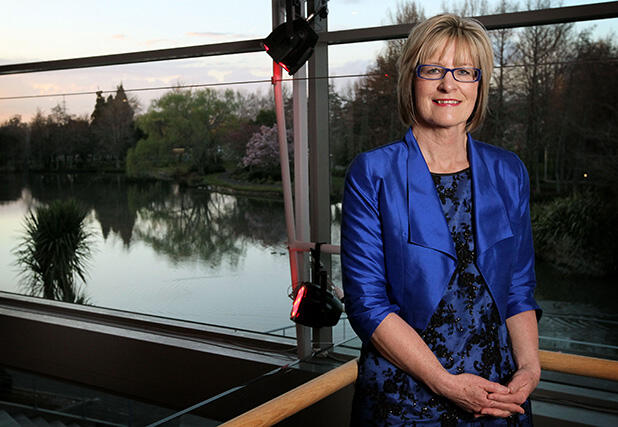
Having worked with society's most at-risk for the past 16 years, the missioner who breezes into Anglican Action's reception area in Hamilton is not the wearied woman you might expect.
Karen Morrison-Hume is immaculate, articulate and engaging, and seemingly as motivated as ever towards helping those who, for whatever reason, have found themselves at the bottom of life's pecking order.
When Mrs Morrison-Hume says on the glass half full or empty scale, hers is "always overflowing", it is easy to believe her.
Her endless enthusiasm for helping others may stem from the fact she does not perceive it as helping at all, instead looking at such interactions as symbiotic.
"The more we go out into these places where life is toughest, the more we'll receive."
On paper it reads like something straight from the Bible, but talking to Mrs Morrison-Hume, who is co-ordinated from her glasses-framed blue eyes to her patent blue shoes, there is no sense of a religious agenda.
She is, however, guided by her spirituality, and part of Anglican Action's work is to guide others to find their own.
Anglican Action, which was Anglican Social Services when Mrs Morrison-Hume joined its ranks, aims for justice through services, and has several arms including residential support for women and their children, and programmes for men, including one for those readjusting to life outside of prison.
The women and children's facility, which houses up to 20 people at a time, is located in the Te Ara Hou social services village in Hamilton's Hillcrest, a place Mrs Morrison-Hume was instrumental in creating.
The women who find their way to the facility, either on their own or by referral, have often hit rock bottom and are at risk of losing their children, she says.
Mrs Morrison-Hume says that during their stays - sometimes as long as nine months - they are taught "a new normal".
She said a real community was built up among the women in the village, and the staff worked hard to replicate that to help the families when they reintegrated into the wider community, where loneliness was one of the biggest challenges they reported.
The facility was partially government funded, and partially funded through philanthropic trusts and fundraising, but the women who stayed there also contributed financially, giving them a "vested interest" in the programme.
The village also has residential artists - who, like poets and writers, have for centuries been champions for restorative justice - and a cafe that acts as a hub for discussion of social issues and concerns.
It is hard to know which of the village's ideas came from humble Mrs Morrison-Hume, but she says she is fortunate to work with a staff of about 50 who share her vision and go with her on her "crazy ideas".
Mrs Morrison-Hume, who received a Distinguished Alumni Award from Waikato University on Friday night, says studying sociology when she was in her mid-30s "liberated" her.
She said it resonated with her in a way that helped her make sense of her life experiences to that point, and it synthesised with her faith.












Comments
Log in or create a user account to comment.