

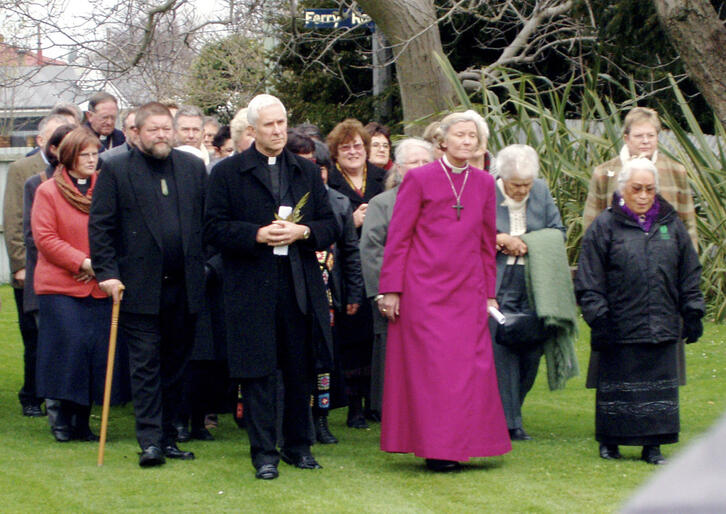
Christchurch’s new Bishop, Canadian Victoria Matthews, received her first taste of marae protocol on Saturday – and suddenly found herself elevated to a place of rare honour.
In a break with Maori tradition, Bishop John Gray (Te Pihopa of Te Waipounamu) invited Bishop Victoria to leave the women’s ranks of the manuhiri to take a seat of authority at the entrance to the wharenui.
She was accompanied by Mollie Pyatt, widow of Bishop Allan Pyatt who in retirement served as a kaumatua to Te Waipounamu.
Bishop Victoria was supported by around 40 members of the diocese in her visitation to the Phillipstown home of Te Waipounamu. Three warriors gave a spirited challenge at the gateway, and a host group performed action songs as the diocesan party advanced cautiously on to the marae.
The diocese, for its part, was well prepared and fielded a full bench of speakers with appropriate waiata.
During the powhiri, Bishop John explained that his invitation to Bishop Victoria to sit up front was both an acknowledgement of her episcopal position and a recognition of the partnership that exists between diocese and hui amorangi.
A cold, leaden sky threatened to dampen the encounter, so Bishop John cut short the powhiri and invited everyone inside the chapel for evening prayer.
In a brief response just before the service, Bishop Victoria expressed delight at the warmth of welcome, even though she found the challenge “terrifying.”
The theme of the service, in Te Reo and English, was apt: “He aroha ki te tangata (Love one another).” Bishop John and Bishop Victoria shared leadership.
In his address, Bishop John sketched the history of the Maori Mission in Christchurch and profiled the various missioners. There was much to laugh about, but also a sharp reminder of the constitutional commitment between diocese and hui amorangi.
“We are brothers and sisters together in Christ,” Bishop John said. “You are my partner, and I am yours. And I’m not going away.”
He didn’t say it in as many words, but the message was clear: Te Waipounamu sees the Anglican partnership taking priority over all other cultural and religious associations. And so should the diocese.
Bishop Victoria was relaxed and gracious throughout the visit, and seems to have struck an early rapport with Bishop John.
Certainly, it was a wise and courteous move to meet Maori on their own ground so early in her term of office. And there were many pointers from her and Bishop John to a closer working relationship between Pakeha and Maori Anglicans in this place.
After dinner, the gathering settled down to an evening of talk and light entertainment.
Bishop Victoria majors on communication
Meanwhile, Bishop Victoria has wasted no time in spurring her diocese to lift its act in proclamation of the Gospel.
In her bishop's charge to synod on September 4 – just a week after her installation – she said the brilliance of the Anglican Church was probably "the best-kept secret in Canterbury-Westland and the Chathams."
"It's time to stop hiding our light under a bushel," she said, laying the communications imperative firmly on laity and clergy alike.
"It is incumbent on every Anglican to be able to confidently speak of our Christian faith," she added. "One of my favourite phrases is 'gossiping the gospel'.
"What that means is that as we go about our daily lives we endeavour to speak honestly and openly about what is most important to us. As disciples of Christ, it's our privilege to share our faith."
Bishop Victoria said she intends to recall synod in six months to present a strategic plan for the diocese. And judging from her charge, that strategy is bound to involve a lift in performance right across the board.
Christchurch has been dogged by a fractious spirit, and many in the diocese are looking to this highly experienced bishop to impose some discipline and lead from the front. Indeed, that's largely the reason why she was elected – that, and her utter commitment to regular prayer, sound education and ordered liturgy.
As she told synod: "We must be careful to provide nothing but the very best in scripture, theology, history, ethics, and pastoral and spiritual formation.
"We often fall into thinking that catchy music or trendy liturgies attract newcomers to Christ. I suggest to you that there is nothing more compelling than excellent liturgy, preaching and holiness of life... We want everyone to strive for excellence in the ministry of the diocese."
The bishop's charge was the highlight of a fairly indifferent synod, and clergy generally were enthusiastic about the stridency of her call for higher professional standards.
On the question of outreach, she said: "I love what we are doing and feel very proud to be bishop. But I don't want us ever to be satisfied. And where is the arm of social advocacy to balance the aim of social service? Where and when is the voice of social justice heard in this diocese?"
She signalled theological education as a personal priority, especially the raising up of young, bright leaders. "Pray for young vocations," she urged synod – "look at the young adults who cross your path and ask them if it is possible that our Lord is calling them to ordered ministry."
Bishop Victoria acknowledged the many changes and challenges facing rural parishes, but she also emphasized that local clergy won't be exempt from her call for excellence. ""At no time is local shared ministry to become second-rate ministry," she said, adding that ongoing training and education of LSM teams and deacons will be a frontline ministry concern for the diocese.
Bishop Victoria concluded her charge with a summary of Lambeth and its effects for the Anglican Communion. "Are we perfect? Not a chance! Are we dying? Not on your life! Do we have a future? Only and always in Christ!"












Comments
Log in or create a user account to comment.