

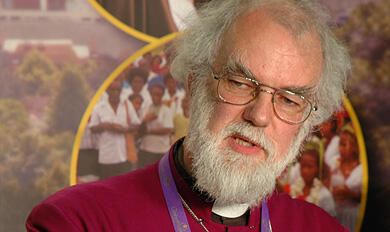
The buses bearing the 2008 Lambeth Conference's 670 purple cassock-clad bishops had barely arrived at Canterbury Cathedral for the 18-day gathering's final Eucharist on August 3 when reactions to the event and its final reflections document began to appear
The reactions ranged across the spectrum of opinion, with some urging decisive action in concert with the comments made in the reflections document and others cautioning against making legislation out of a document that is a self-described narrative of the conference
Noticeably quiet on that day was the Global Anglican Future Conference, which held a June gathering of conservative Anglicans and Episcopalians in Jerusalem. Its silence was noteworthy considering that the absence of the so-called GAFCON bishops is referenced in the introductory section of the reflections document
Archbishop of Canterbury Rowan Williams said near the end of his final address that "in the months ahead it will be important to invite those absent from Lambeth to be involved in these next stages" of the efforts to maintain the communion. "Much in the GAFCON documents is consonant with much of what we have sought to say and do, and we need to look for the best ways of building bridges here," he said
Sydney Archbishop Peter Jensen, who emerged as a GAFCON leader during its June gathering in Jerusalem, said on August 4 in a short news release that "our absence focused minds on the problems within the Communion and spoke louder than our presence would have.
A two-sentence statement appeared on August 4 on GAFCON's website, saying: "The Primates' Council of GAFCON will wish to study the outcome of the Lambeth Conference carefully and consult with those they are leading. They are meeting towards the end of August and will make their response following that meeting.
There was still a day to go before the reflections document was released when the bishops of Egypt, North Africa and the Horn of Africa issued a statement on August 2 calling for "a spirit of mutual submission to prevail and for unity to be restored.
Bishops Mouneer Anis, Derek Eaton, and Andrew Proud said the gathering had been a "most valuable opportunity to express our thoughts and concerns and to listen to the concerns of others."
They called for movement on the Windsor continuation process, the Anglican covenant and the moratoria -- called for in the Windsor Report -- on authorizing public rites for blessing same-gender relationships, consecrating people involved in same-gender relationships and crossing diocesan and provincial borders to exercise episcopal ministry
The three argue that the first two moratoria "pertain to central moral teaching while the last is a matter simply of administration and good order.
Anis, the primate of Jerusalem and the Middle East, is also one of the signatories of a statement issued on August 3 by the self-identified members of the Anglican Global South.
The statement came rom the Lambeth Conference, according to the text, and is currently also signed by bishops and primates Ian Ernest (Indian Ocean), Bernard Ntahoturi (Burundi), Dirokpa Balufuga Fidèle (Congo), John Chew (Southeast Asia), Stephen Than Myint Oo (Myanmar), Valentino Mokiwa (Tanzania), Daniel Deng Bul Yak (Sudan), and Justice Ofei Akrofi (West Africa), John Wilson Gladstone (South India) and Donald Mtetemela (Tanzania). The current version of the statement notes that the list of signers is being updated
The signers said they "stand in solidarity with all the faithful Bishops, Clergy and Laity in the United States and Canada and elsewhere who are suffering recrimination and hostility perpetrated upon them by their dioceses and/or national churches which have not unequivocally complied with the specific Windsor proposals required of them in full."
They said the Communion "is at the probable brink of collapse" and that the May 2009 meeting of the Anglican Consultative Council (ACC) ought to endorse the proposed Anglican covenant. They called on the Lambeth Conference to give "clear endorsement and immediate implementation" of the Windsor Continuation Group's July 29 proposal for a pastoral forum
The continuation group, charged with the implementation of the some of the Windsor Report's recommendations, proposed that the forum would rapidly "engage theologically and practically with situations of controversy as they arise or divisive actions that may be taken around the Communion."
The forum could "offer pastoral advice and guidelines." It could also develop a plan to hold "in trust" alternative Anglican groups that have attempted to organize people who disagree with the Episcopal Church's stance on the issues involved in the moratoria so that they can prepare "for their reconciliation within their proper provinces," the continuation group said
While the reflections document says the idea of a pastoral forum was supported by many Lambeth bishops, it did not outline the implementation the statement signers called for. Dr Williams said in his last presidential address that he would "look within the next two months for a clear and detailed specification for the task and composition of a pastoral forum." He did not say where that "specification" would come from, although the continuation group has said it will meet in the fall to consider what it heard from bishops at Lambeth
The Global South leaders' statement also charges that "substantial theological voices outside of the Western world have not been present in the evening plenary sessions of the Lambeth Conference," calling it an example of the "continuing patronising attitude of the West towards the rest of the churches worldwide."
The signers deem the perceived lack to be part of what they call "attempts to cause divisions and break the bonds between churches in the Global South," adding that "the realities in our churches are often misrepresented and misunderstood in the West.
The statement says the Global South Primates' Steering Committee will meet soon to discuss "how to move the global Anglican Communion substantially and effectively forward." The signers pledge to work with "all orthodox groups in the United States of America and Canada: to listen together to what Lord Jesus says to his church today, to draw strength and insights from one another, and to take fresh initiatives in upholding and passing on the faith once delivered to the saints.
On the day after the conference, Bishop Marc Andrus (California) described as "profound and generous"
Dr Williams' suggestion in his final presidential address that "there will be some who cannot abide by these moratoria, and in this they signal that there are steps to deeper unity they cannot take; or it may be that they conceive of deeper unity in other ways.
Andrus said California would not abide by the moratorium on same-sex blessings but that he takes it "as incumbent on me and on us in the diocese to actively labour to both understand the position of those to whom that moratorium is important, and to convey the reality of our life together to the world.
Andrus echoed others' reactions when he noted that "the document is not legislation.
"We will pay close attention to it, but we must not reify the agreement points in it into laws, and we should resist interpretations that seek to employ those agreements as laws," he wrote.
Bishop Jeffrey Lee (Chicago) said on August 3 that he had come to understand "like never before" how physically dangerous it can be for some Anglicans to discuss homosexuality. He said he came "face-to-face with fellow believers who hold a view of Scripture that I cannot understand."
Lee said that he did not get answers to the questions he asked them about how the issue of the full inclusion of homosexual persons can rise "to the level of saving [the] faith or should be the cause of the breaking of communion.
Before the reflections document was released on the afternoon of August 3, Bishop Mark Lawrence (Suth Carolina), who later called Dr Williams' comment about GAFCON "a crucial and gracious overture," told reporters that he had witnessed a "new prince" being born at the group's Jerusalem meeting
"It was an awkward and messy birth," he said, reading from what he called his "morning meditation." Lawrence said he knew that his role is now to "hold together as much as I can for as long as I can that when he comes to his rightful place on St Augustine's throne in Canterbury Cathedral he will have a faithful and richly textured kingdom.
The Rev Mary Frances Schjonberg is Episcopal Life Media correspondent for Episcopal Church governance, structure, and trends.
How the press see it...
Martin Beckford in the London Daily Telegraph:
http://www.telegraph.co.uk/news/uknews/2494254/Lambeth-Conference-QandA-What-has-it-achieved.html
Riazat Butt in the London Guardian:
http://www.guardian.co.uk/world/2008/aug/04/anglicanism.religion?gusrc=rss&feed=networkfront
Ruth Gledhill in the London Times:
http://www.timesonline.co.uk/tol/comment/faith/article4452635.ece










Comments
Log in or create a user account to comment.