

“I’m going to the Festival of Homiletics!”
“The what?” people would reply.
“It’s a week-long festival of preaching.”
“Right … a festival?”
Could festival and preaching be included in the same sentence?
A festival it was: 2000 people, 25 presenters preaching and lecturing including “superstars” Barbara Brown Taylor, Walter Brueggeman, Thomas Long, Diana Butler Bass, William Willimon and Otis Moss.
There are festival groupies too; some people attend every year. There is music, worship, bookstores and church artistic ware on sale. Forced to choose between presenters who are on at the same time, people dash from one location to another to fit in as much as possible.
The really dedicated can fit in four worship services with a sermon each and two lectures per day or three services and three lectures per day. Uplifted by music from top-class organists, guitarists and choirs we made it through.
The festival moves around the USA and this year was in Minneapolis in a warm spring week with the locals clearly reveling in the departure of the snow and flocking to out door cafes. (In the main street is a statue of Mary Tyler Moore throwing her hat in the air as she did every week on the show set in Minneapolis.)
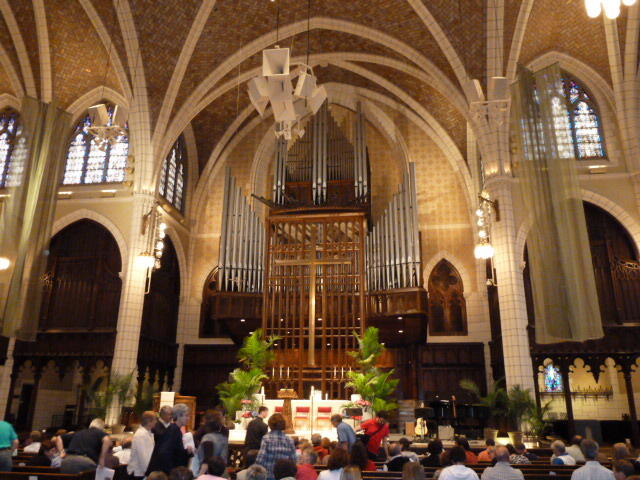
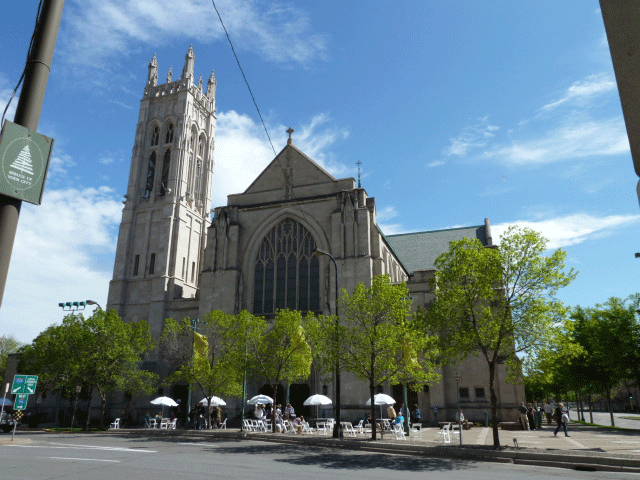
We gathered in the huge downtown churches: Central Lutheran Church, being the main venue as it does indeed seat 2000 and the four-manual Casavant organ, was able to cope with the singing of so many voices.
The theme of the festival was “Preaching in a Changing Culture”, as the US church finally has to grapple with declining numbers and an emerging secular culture. For many this still seemed to be a new idea and something they are not equipped to deal with.
In a church which has often allowed itself to be separate from the world and to see the world as evil or at least “other,” Barbara Brown Taylor reminded listeners that the world is God’s good creation and that the sacraments of the church are where we learn the language and patterns to recognise God in the world.
Walter Brueggeman challenged preachers not to stay silent in the face of political and economic challenges. He said if we stay silent we will be like Jeremiah “with a burning fire shut up in our bones” (Jer 20:9).
He said one of the reasons so many clergy leave the ministry or burn out is because we fail to speak the truth of the Gospel, and it's killing us. I saw quite a few men in tears at the end of his sermon, preachers who looked like they might be at the end of their careers, and they wept as Professor Brueggeman admonished and encouraged us. He received a standing ovation for his sermon.
Not every sermon was a winner; it was a relief to see that even those who are expected to be great are not always. I won’t name those who I didn’t appreciate but in both cases it was interesting to analyse why: these preachers took no account of their context.
They preached a sermon which they might have preached anywhere, as if they had picked an old sermon out of the files. The sermons might have worked somewhere else but a good sermon always grounds itself in the context of the listeners.
Even with 2000 people from across the USA and the world there was a context of listeners with a shared passion: preaching. One of these not so great preachers had a complete disconnect in tone, delivery and content. A superior tone while trying to convince us he understood us did not work at all. A lack of authenticity in a preacher loses your congregation in the first 60 seconds.
The other preacher to get a standing ovation was Otis Moss, from Trinity Church in Chicago (made famous by being Barack Obama’s family church). In the amazing style which is black preaching he made a passage from Ezra - yes Ezra! - come alive (Ezra 3:8-13).
He spoke about the new young clergy who want to preach a new gospel but they cannot succeed if they forget the “blues” of those church leaders who have been through the years since before the Civil Rights movement and the “blues” of life since.
“You cannot preach the gospel without the blues moan” was his refrain. Without lament our praise is empty.
A festival it was, a feast of words, music and the ordinary faith of ordinary preachers. We were inspired by those we listened to and inspired by the fact that 2000 other people cared enough about preaching to spend a week of their busy pastoral lives focused on the art and skill of proclaiming the gospel.
Next year is the 20th anniversary of the Festival and it will be in Atlanta, Georgia, May 14-18, 2012; http://goodpreacher.com.
Aspiring and experienced preachers, especially those contemplating sabbaticals – mark your calendars!
The very Rev Helen Jacobi is Dean of Waiapu












Comments
Log in or create a user account to comment.