Go to your knees often, consult widely, and get smart via the latest information technology…
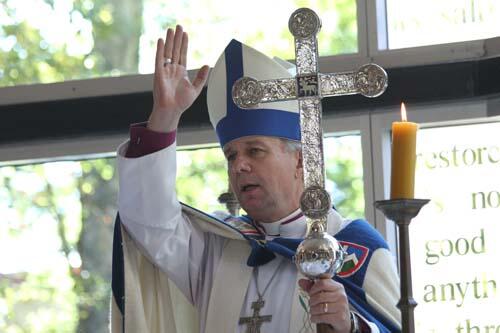
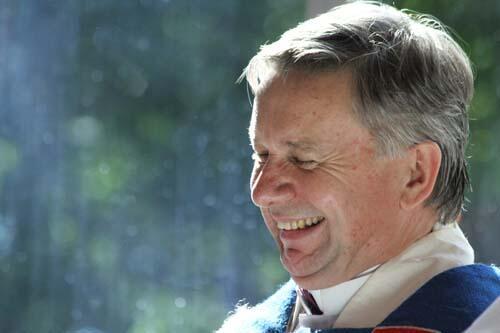
That was Archbishop David Moxon’s advice to his successor as he took leave of Waikato to begin a new job in Rome.
Archbishop David is now the Anglican Communion’s chief representative to the Roman Catholic Church, and also Director of the Anglican Centre in Rome. It’s a far cry from Hamilton, his Episcopal home for close on 20 years.
But while he’s excited by the potential of a global ministry, Archbishop David also knows that it’s the Church of Aotearoa, New Zealand and Polynesia that has shaped and equipped him for such a far-reaching task.
Anglican Taonga put the following questions to the departing Archbishop to find out precisely what drives him on the road to Rome...
You describe yourself as “Reformed Catholic.” How will that go down in Rome?
In Rome I will describe myself as an Anglican. But I would also say that this means being part of one holy, catholic and apostolic church, which for Anglicans comes originally from the ancient church of the English-speaking peoples. This church joined the Roman Catholic Church at the Council of Whitby but separated off with the Reformation. So for this reason we are catholic and reformed.
How would you define “Reformed Catholic” as opposed to “Evangelical”?
This means keeping the heritage of the early church and its roots while recognizing that this heritage always needs to be reviewed in prayer and Bible study and robust dialogue in every generation, to be faithful to mission in our day. Being evangelical is a crucial part of being Christian at any time.
The aim of the Anglican Centre in Rome is to “promote Christian unity in a divided world.” How do you intend to further that aim?
By pointing to and enabling examples of co-operation in mission, especially in Christian justice and development work. We don't agree on some significant things but we can labour together for the kingdom where the needs are greatest in God’s world.
You have piloted this church through some choppy waters, not least of all the hermeneutical debate on same-sex blessings. What's your view of the way the church is processing this issue?
I think we are being careful to use biblical principles of consultation, prayer, and Bible study over time: listening deeply to each other, and to those most affected by the churches’ response.
We will need to pray our way through what choices General Synod faces well beforehand so that when the next synod meets we will be ready to respond with maturity and care for everyone involved. We will be describing our unity in our diversity in special ways. We ought to be capable of this without breaking up.
You have the happy knack of staying calm through torrid debates, even when you’re chairing them. What’s your secret?
It's no secret. Just pray before, during and after the debate. Remember that the church has always struggled at times, but that it is Christ’s Body on earth and is ultimately a communion of Christ-like love, even if it is a tough kind of love occasionally.
Which forms of prayer work best for you?
I use Ignatian forms of prayer a lot. I often go to the Sacred Space website run by the Irish Jesuits. I also use the Jesus prayer and breathe the words.
Some Anglicans believe our three-tikanga constitution is biblically flawed because it divides the church along ethnic lines. Do you think the structure has lived up to its promise across the church?
I think our three-tikanga church is a taonga that has offered us a unique and rich experience of Christ in cultural diversity. It is also just and free in spirit for different indigenous communities. Whenever we experience tensions in this arrangement or disappoint each other, which we do from time to time, it is good to remember that human beings and human cultures are not always allies capable of these things whatever the structural arrangements. In the end we have to choose to work in the relationships or not, to persevere or not to love or not. These are the ultimate biblical choices at any time with anyone.
As Archbishop you’ve often played a balancing role in the struggle between liberals and conservatives. Is schism still a possibility for this church, or do you believe we’ll stick together regardless?
Schism is always a possibility where human beings are organized in large and diverse networks. However, I don’t think it is likely in this church because of the ability and spirituality of the key people involved. There is a Kiwi Christian way of trying to provide a fair go for everyone because we live with only one or two degrees of separation in these islands. Maybe we can show the world what unity in diversity can look like, through our common grounding in Christ. There is no other ground of our being in the end. This is where we can stand together.
Formal liturgy has always been a staple of Anglican worship. And yet many of our most successful parishes – St Paul’s, Symonds Street, for example – are much less formal. Is that the way to go for growth, especially among the young?
I have seen some great examples of youth folk liturgy and music where informality combines with sound liturgical shaping, without being stodgy or boring. One without the other will be inadequate in the long run.
How do you think the Anglican Church will hold up in the current Census?
There will be a decline in our proportional place owing to immigration of Catholics and the rise of agnostics.
What have been the high points of your term as Archbishop?
• The ordination of bishops.
• The stand for the reform of the Crimes Act which saw this church as one of the only ones to support the abolition of bruise-causing striking of children.
• The combined approach of church leaders to Parliament on issues such as crime and punishment, social housing, benefit levels and poverty.
• The hermeneutics hui series.
• The Bible in the Life of the Church project.
• The hosting of the Anglican Consultative Council.
• The defence of prayer in schools nationally.
• The courage and creativity of the Bishop and Diocese of Christchurch following the earthquakes.
• The primates’ conference in Alexandria, Egypt.
• The challenge of alcohol reform.
• The partnership between the primates.
And the low points?
The pain around the Te Aute debate at the last General Synod.
Apart from the Bible, which books have been most helpful to your ministry?
Poet and Peasant by Ken Bailey
The Interpreters Dictionary of the Bible
Falling Upwards by Richard Rhor
A Theology of Hope by Jurgen Moltman
Most of Walter Brueggemann’s work
Which films or DVDs have you most enjoyed over the past 10 years?
A Good Year
Brother Sun Sister Moon
Molokai
The Mission
The Vicar of Dibley
Who are your heroes, inside and outside the church?
Desmond Tutu, Paul Reeves, Te Whiti o Rongmai, William Wilberforce, Damian of Molokai, the late Maori Queen, Te Arikinui Te Atairangikahu, Francis and Clare of Assisi.
You’ve held together two punishing jobs – Archbishop and Diocesan Bishop – for seven years. Has there been a personal cost?
Yes. To my family and sense of peace at times
So how do you relax after a hard day?
I go to the sacred space site and pray there, I might have a long hot bath, read a good book, jog and exercise.
Finally, what advice do you have for your successor?
Go to your knees often, consult widely, use as much information technology as you can to be working smarter. Get regular high-quality supervision and spiritual direction. Don't be afraid but trust in God.


Comments
Log in or create a user account to comment.