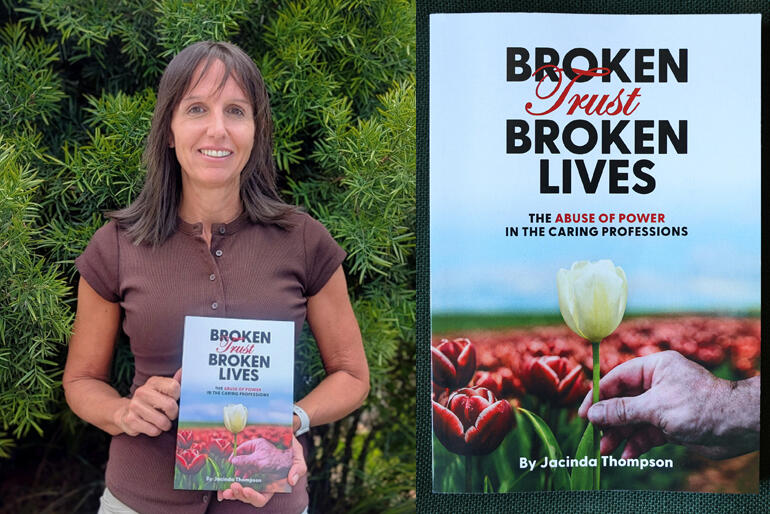
Jacinda Thompson's new book "Broken Trust, Broken Lives: The Abuse of Power in the Caring Professions" is a well-researched, expertly-argued roadmap to equip all those involved in caring professions to prevent abuse.
Jacinda sets out why and how churches and other caring professions in Aotearoa New Zealand fail to build vigilant cultures of safeguarding that protect vulnerable people and respond well to the needs of victims.
What stands out in this book is its practical plans for action that give readers clear directions on how to severely limit abusers' chances to operate in any pāriha or ministry that heeds her recommendations.
Each chapter deals with a different aspect of abuse, prefaced by Jacinda Thompson's courageous retelling of her own experiences of the sexual abuse she suffered in the context of grief counselling by a (now former) Anglican priest. She also describes the impact of failures by the church to respond appropriately to her disclosure, or to place her wellbeing at the top of their concerns.
Jacinda's retelling syncs perfectly with her analysis of how abusers mobilise social shaming, victim trauma, and grooming to conceal ongoing abuse, while manipulating not only victims, but whole families, communities and their leaders to believe in the abuser's trustworthiness.
Chapter one on 'The reality of abuse in care professions,' looks at data from perpetrator's self-reporting and investigations into abuse across care professions overseas and in Aotearoa and looks at the myth-breaking true character of abusers.
Unlike the false stereotypes of 'monster' or 'loner pervert', Jacinda presents evidence that proves abuse is carried out by a wide range of individuals and personalities, affected by many psychological factors.
She outlines the varied attitudes (while often consistent behaviours) of those who abuse through their roles as doctors, nurses, counsellors, teachers, priests, church workers, youth workers and other care professionals, including volunteers.
Chapter two on 'Understanding power imbalance and vulnerability,' unpacks how perpetrator power and authority interact with victim vulnerability to create situations where consent is not possible, so cannot qualify as a defence for sexual assault.
Chapters 3-4 look at the consequences of abuse-related trauma on victims' long-term medical, social, psychological, financial and general wellbeing and how uninformed responses to abuse disclosure can cause more pain and distress to survivors, and at worst prevent them from being able to speak out or receive help at all.
The revelatory chapter five uncovers the frustrating limits of redress in New Zealand law and other legal jurisdictions when misplaced public notions of consent match legal definitions that ignore the imbalance of power in professional caring relationships.
While pulling no punches, this book is refreshingly balanced and offers data-backed perspectives that will shift the reader not only toward a genuine change in awareness and attitude, but most importantly of future practice.
'Broken Trust, Broken Lives' stands out for its calm and practical tone amongst the large quantity of news articles, Royal Commission proceedings and reports, international and local safeguarding policies and guidelines, and theological treatises that deal with the topic of abuse.
Jacinda introduces complaints systems and safeguarding rules that not only clearly show what our hāhi must do to "do better", but explains exactly how those changes work, why they work, and how the right systems are shown to interrupt and disable abusive behaviours.
For example, she explains how clearly defined rules like "no adult can be alone in a car with a child", and "no one-to-one pastoral care meetings can take place outside the church hall in sight of office staff" prevent abusers from gaining access to vulnerable people.
She sets out how clear rules like these notify everyone in a community that specific activities are unacceptable, so that the whole community is on guard, and knows when a clear rule is broken. In that way, clearly defined rules disturb not only the conditions for abuse, but the anonymity of abuse, by raising the awareness of a whole community.
In sum, this book is a thorough and timely insight into a field that is still widely misunderstood throughout society and the caring professions.
As a well-executed backgrounder on how abuse is unwittingly enabled by ill-equipped organisations, this easy-to-read 180-page paperback makes a strong contribution to this Church's desired shift into a widespread culture of 'Safe Church.'
"Broken Trust, Broken Lives" by Jacinda Thompson will be a valuable addition to the reading list of every Anglican leader, ministry educator, kaiako, minita, safeguarding officer, boundaries trainer, kaimahi and person in training for ministry in this Church.
Paperbacks cost $38 or $45.00 incl.p&p and E-book copies are available on Apple Books for $19.99


Comments
Log in or create a user account to comment.